Salzburg: A City with More Layers Than You’d Expect
Two and a half hours by train west of Vienna, you arrive in Salzburg.
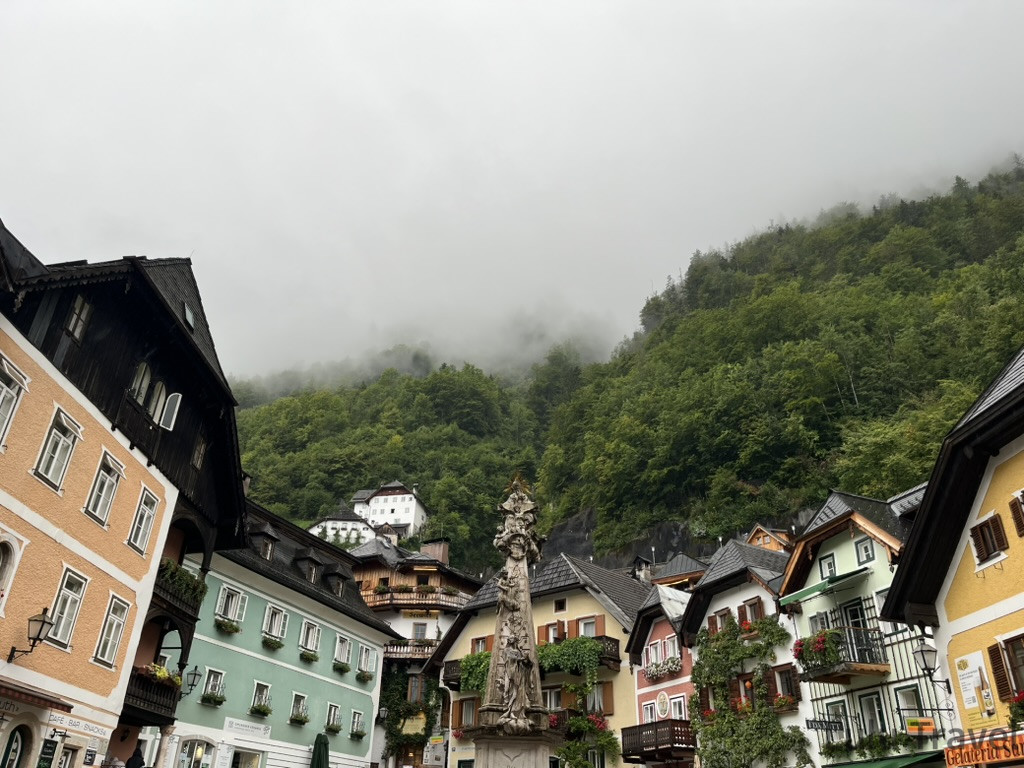
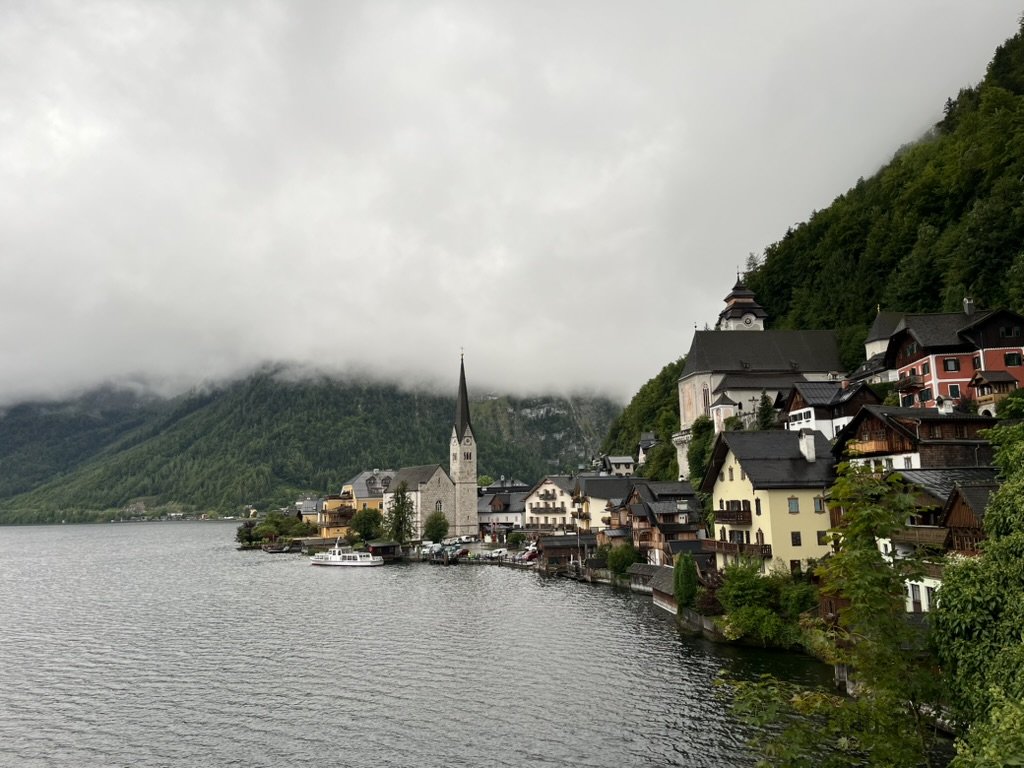
Many travellers treat it as little more than a launchpad for a day trip to Hallstatt, stopping for a night or two before moving on. But if you’re willing to give the city a little more of your time, Salzburg offers far more than a transit node. It’s a place of vast Baroque cathedral squares, medieval fortresses offering sweeping panoramic views, palace gardens that possess a serene beauty even in the rain, and — most unexpectedly — a 1750s water-powered mechanical theater that you have to see in motion to believe.
This post records my two days in Salzburg, with a note on arranging the Hallstatt day trip at the end. For those interested in the full context of my Europe trip with elderly family, you can read my guide on planning intergenerational travel here: Traveling Europe with Elderly Family — Planning Logic and Honest Reflections

The Old Town — Walking Into Baroque Daily Life
Salzburg’s Old Town is a UNESCO World Heritage Site, the entire area reachable on foot, about 20 minutes walk from the train station or a few bus stops away.
We bought a 48-hour city card, which covers unlimited public transport (excluding S-Bahn city rail) and entry to several attractions.
The main commercial street is Getreidegasse — and what makes it distinctive isn’t the shops but the ironwork hanging signs above each one. Every premises has a different hand-forged wrought-iron bracket: pharmacies, cafes, bakeries, all of them. Walking this street and simply reading the signs is something in itself. Mozart’s birthplace is also on this street, marked with a commemorative plaque on the exterior wall.


The Alter Markt is the core of the Old Town, enclosed by historic buildings with a Baroque sculptural fountain at its centre. The adjacent Café Tomaselli — one of Salzburg’s oldest cafés — has green-and-white striped awnings and pink flowers blooming from the second-floor balcony, impossible to overlook. On a good day the outdoor seats are almost entirely full.

Salzburg Cathedral — Worth Going Inside
Salzburg Cathedral stands beside the central plaza of the Old Town, built in the 17th century with a white Baroque facade flanked by two saint statues guarding the arched entrance. The founding year 1628 is marked above the main doors.
The interior dome, frescoes and altar are on an impressive scale. Side aisles have prayer areas where you can light candles — rows of small red flames in a dim, quiet space. The painting above the main altar is monumental in scale, lit beautifully by the circular dome above it.
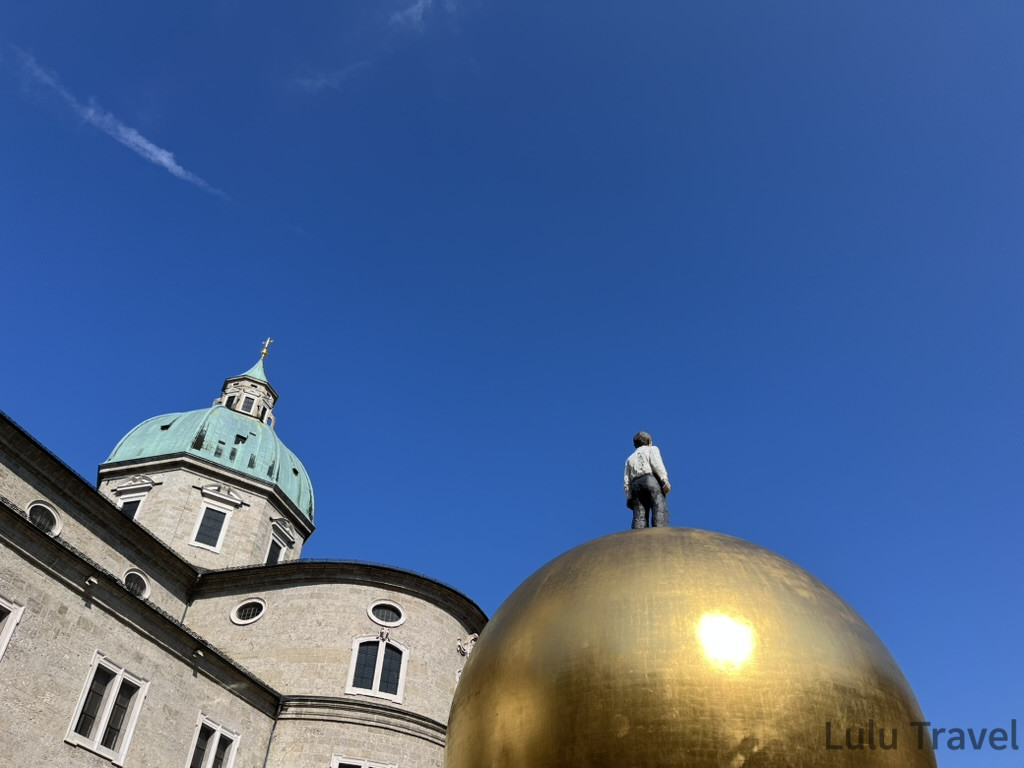
Outside the square there is a large gilded sphere sculpture — frequently photographed — with a tiny human figure standing on top. The contrast between that miniature figure and the cathedral’s green dome behind it, against a blue sky, is one of the better composed angles in the Old Town.


Hohensalzburg Fortress — Overlooking the City from the Summit
Hohensalzburg Fortress (Festung Hohensalzburg) is one of the best-preserved medieval castles in Europe, visible from almost anywhere in the Old Town as it dominates the hill above.
There are two ways up: climbing the stone steps on foot, or taking the Festungsbahn cable car. The cable car passes through a section of mountain tunnel — emerging from the dark into daylight at the summit has a satisfying sense of ceremony about it.
The fortress itself has heavy grey stone walls, a circular tower at the entrance, defensive ramparts, viewpoints and several historical exhibition rooms. What leaves the strongest impression though is the view from the ramparts looking down — the rooftops of Salzburg’s Old Town, the curve of the Salzach River, the distant mountains all laid out below you at once.
When I visited, the sky was overcast. The cloud cover gave the city a grey-blue cast — something between a painting and a photograph, dense and slow.

Victorian Costume Photography — A Step Back in Time
After taking the cable car down from the fortress, there is a studio offering Victorian-era costume photography: formal gowns, hats, parasols and wigs available to hire, photographed against a lit backdrop in a style that mimics antique portrait photography. The finished prints come mounted on thick card with gold-trim borders — the effect of actually stepping out of an old photograph.
We were dressed up like porcelain dolls — into full-length petticoat dresses, fitted with wigs and headpieces, handed lace parasols — and a few minutes later we were standing in front of a backdrop being photographed. For anyone drawn to unusual experiences, it’s worth working into the itinerary. It also works well as an activity to do with elderly family members.


Mirabell Gardens — Rain Has Its Own Atmosphere
Mirabell Gardens (Mirabellgarten) is across the Salzach from the Old Town, about 15 minutes on foot. This is where the Do-Re-Mi scene from The Sound of Music was filmed. The geometrically symmetrical flowerbeds, fountain and sculptures are well-suited to photography.
It was raining when I visited, which meant far fewer tourists than on a clear day, and the garden had an uncommon quiet to it. Red and amber-yellow flowers filled the beds, wooden benches dotted around the sculptures. Even in rain it had its own particular atmosphere. From the back of the garden there is an unobstructed view of Hohensalzburg Fortress — a way to get the castle in the frame without climbing up to it.


Hellbrunn Palace — The Most Surprising Attraction in Salzburg
Schloss Hellbrunn is a 17th-century palace on the outskirts of Salzburg, about 20 minutes by bus from the city centre. Many visitors don’t know about it, but almost everyone who goes comes back calling it one of Salzburg’s most interesting stops.
The Water Garden (Wasserspiele) is a garden behind the palace full of concealed water mechanisms — hidden jets beneath stone table surfaces, chair seats, bridges — all originally designed by the Prince-Archbishop as pranks to drench his guests, and all still fully operational today. A guide leads you through, explaining the engineering logic behind each one. It is one of the few cultural visits where you spend half the time laughing and half learning.
Along a stone-channelled waterway in the courtyard, two stone-carved turtles are positioned facing each other — look carefully and the streams from their mouths intersect mid-air.


The Mechanical Theatre was the single most unexpected thing I encountered in Salzburg. A large Baroque architectural model populated by hundreds of wooden figurines representing 18th-century city life — craftsmen, merchants, horse-drawn carriages, soldiers — all driven simultaneously by a single hydraulic mechanism.
Built in the 1750s, it is preserved in a semi-open outdoor space and can be seen in rain. The density of figures and the level of detail are such that you can stand in front of it for several minutes without exhausting what there is to see.

Mozartkugel — The Salzburg Souvenir to Buy
Salzburg’s signature souvenir is the Mozartkugel — a chocolate sphere wrapped in blue and silver foil printed with Mozart’s profile. The filling is pistachio marzipan and dark chocolate. You will find them everywhere.
Look at the brand on the packaging. The original Fürst version and the mass-produced supermarket version taste noticeably different. If you’re bringing them as gifts, look for the original.

Getting from Salzburg to Hallstatt
Salzburg is the most convenient base for reaching Hallstatt. There are shared day-trip tours available from the city, with a journey time of around 1.5 hours each way. Because Hallstatt accommodation is expensive and books out well in advance, most people choose to do it as a day trip from Salzburg.
My actual experience: Hallstatt day trip— Honest Notes from a Rainy Day Trip out of Salzburg
fAQ
How many days should I spend in Salzburg? Is it worth more than a transit stop?
Two days is a comfortable length — using it only as a transit stop is genuinely a waste.
The Old Town, the fortress, Mirabell Gardens and Hellbrunn Palace each need half a day to a full day.
If you only have one day, the Old Town and fortress are the core — the rest can be added based on energy.
Is the Salzburg city card worth buying?
Depends on how dense your itinerary is.
The 48-hour card covers public transport and some attraction entry. If you’re seriously hitting the sights over two days it usually works out cheaper than buying individual tickets. The fortress cable car and Hellbrunn Palace are both included — combined, those two alone come close to the card price, making the public transport effectively free on top.
Does Hellbrunn’s Water Garden require a guide? Can I understand it on my own?
Yes, a guide is required — and it genuinely matters.
The water mechanisms are distributed throughout the garden, and without a guide you’d have no way of knowing where they are or what the logic behind each design was.
The whole point is following the guide, hearing the explanation, and then getting sprayed — that interactive element is simply not there if you wander through alone. The guide is included in the ticket price at no extra charge.
Which version of the Mozartkugel is worth buying?
There is a clear difference in taste between the original Fürst version and the mass-market variety.
The Fürst version has a higher proportion of pistachio marzipan filling and a thinner chocolate shell — the flavours are more distinct and layered. The mass-market version is sweeter and more uniform throughout.